
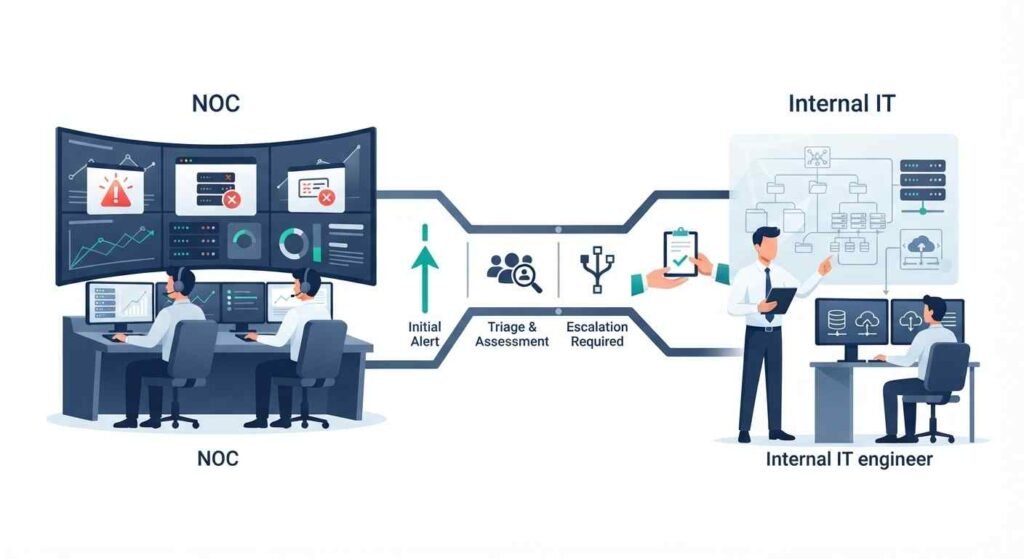
Why Escalation Breaks Down When Roles Are Implicit
When an alert arrives after hours, both internal IT and the network operations center should know who responds first. Unclear ownership can leave an issue waiting or send several people through the same checks. Defined escalation paths help teams hand over work with the information the next person needs.
That is where a well-designed escalation model matters. It turns operational noise into a structured process. Instead of asking, “Who owns this now?” teams already know when the NOC should investigate, when internal IT should step in, and when leadership should be informed. Netcuras approaches this kind of operational discipline as a practical requirement, not a luxury.
A useful escalation model does more than route tickets. It creates confidence. Internal teams can focus on systems that require institutional knowledge, while the NOC handles the continuous vigilance that keeps incidents from getting worse. Done well, this is not about adding bureaucracy. It is about preventing ambiguity from becoming downtime.
What the NOC Should Own, and What Internal IT Should Keep
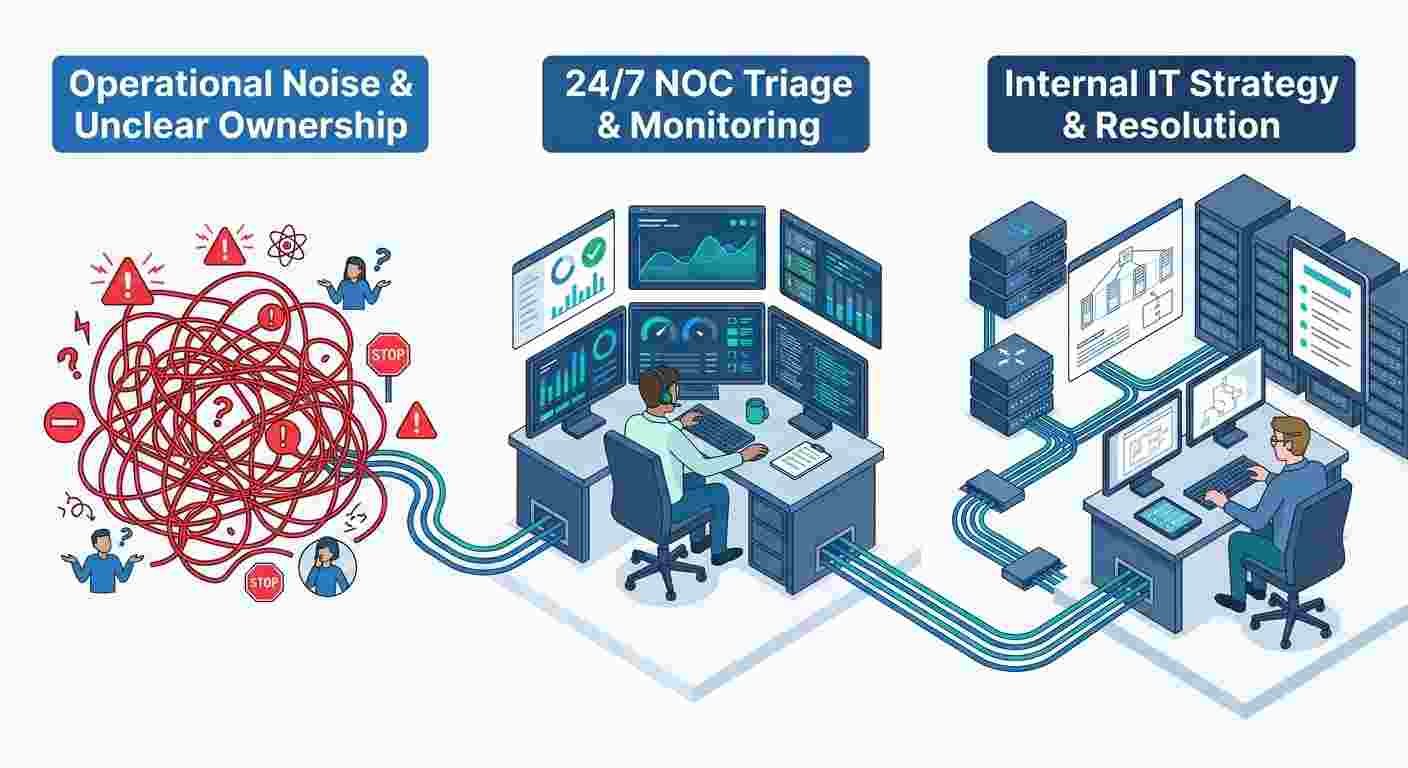
The most effective escalation paths begin with a simple principle: every issue should have a first owner, a second owner, and a clear trigger for transfer. That sounds basic, but many organizations skip the definition work and rely on tribal knowledge. The problem is that tribal knowledge does not scale, especially outside business hours.
The NOC should own continuous monitoring, alert triage, initial diagnosis, and incident communication around infrastructure events. Internal IT should retain ownership of systems strategy, business-specific application decisions, architecture changes, and issues that require privileged context or approval. Netcuras fits naturally into the first category by providing 24/7 monitoring and incident management across infrastructure layers.
A strong division of labor avoids two common failures. The first is over-escalation, where every alert is handed to internal IT before the issue is understood. The second is under-escalation, where the NOC stays too long with a problem that clearly needs specialized internal input. Either mistake slows recovery.
The Boundary Should Be Based on Triggers, Not Guesswork
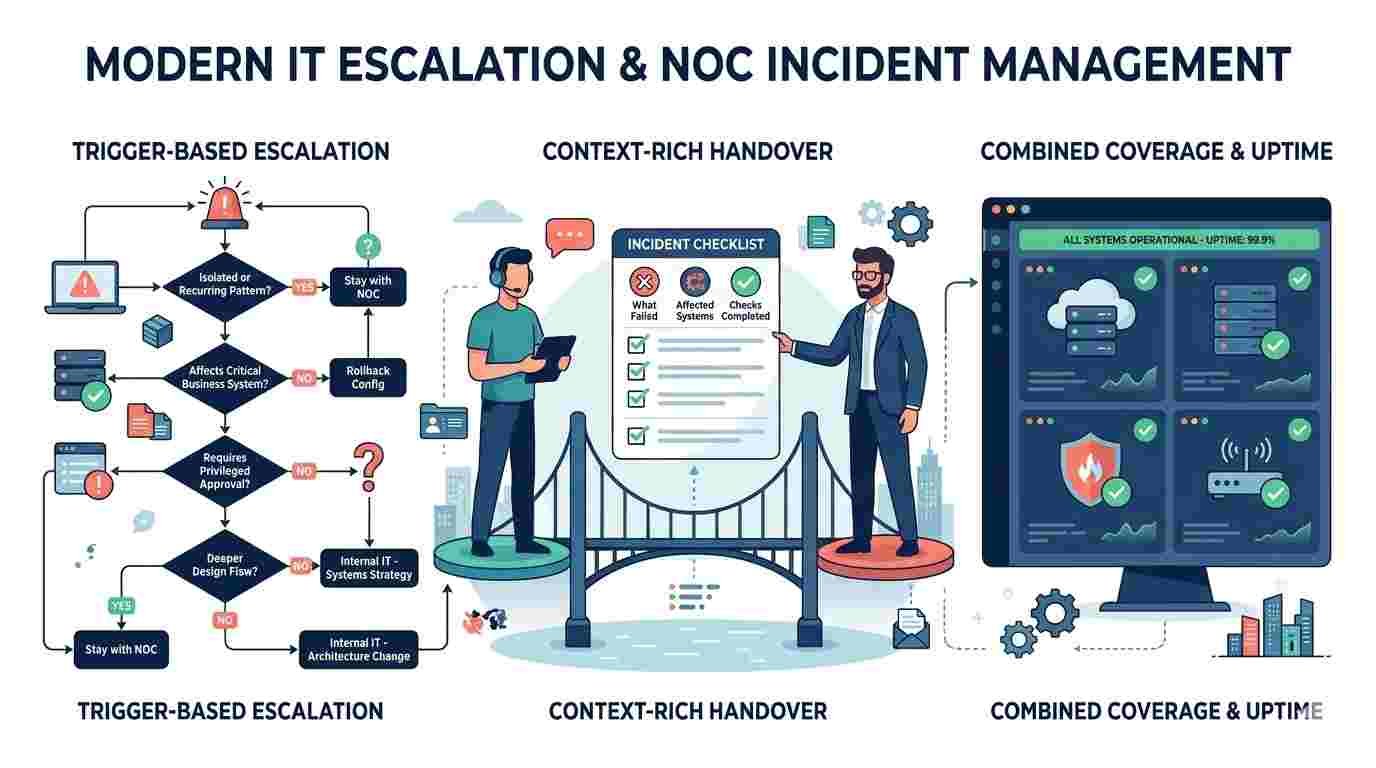
Escalation works best when it is driven by observable conditions rather than opinion. For example, an alert that resolves after a quick configuration rollback may stay with the NOC. A recurring pattern across multiple devices, a failure tied to a business-critical application, or an issue that suggests a broader architecture problem may require internal IT involvement.
The most useful trigger questions are straightforward:
- Is the issue isolated or recurring?
- Does the NOC have enough data to continue diagnosis?
- Does the problem affect a business-critical system or service?
- Does the next step require internal knowledge, approval, or change control?
- Is the issue operational, or does it point to a deeper design flaw?
These questions matter because they replace subjective judgment with a repeatable process. That is one of the main reasons organizations invest in NOC support services: not just to watch systems, but to reduce uncertainty in the first minutes of an incident.
Escalation Is Not the Same as Hand-Off
A mature process keeps the NOC involved even after escalation. The goal is not to dump a ticket and disappear. The goal is to transfer context cleanly, then keep supporting the incident until resolution. That means documenting what was observed, what has already been tried, what systems are affected, and what changed immediately before the alert.
When Netcuras supports this model, the value is not only speed. It is continuity. Internal IT receives a clearer picture, which reduces rework and shortens the path to a fix. That is especially important when multiple teams touch the same environment, such as network, server, cloud, and security operations.
How Clear Escalation Protects Uptime, Focus, and Accountability

Escalation paths are often described as an operational convenience. In reality, they affect business performance. The right structure helps organizations avoid stalled incidents, reduce after-hours interruptions, and preserve internal engineering time for work that actually moves the business forward.
The first advantage is faster containment. A well-run NOC spots anomalies early, filters out false positives, and identifies real incidents before they become broad outages. The second advantage is better focus. Internal IT is not forced to chase every overnight alert or routine infrastructure issue. The third advantage is accountability. When roles are clear, no one needs to interpret responsibility in the middle of a crisis.
This is where Netcuras is especially relevant. Its monitoring and incident management model is designed to support the handoff between vigilance and decision-making, not to blur it. That distinction matters because a team that is constantly interrupted by operational noise tends to spend less time on strategic improvements.
What Strong Operators Document Before an Escalation Happens
The best escalation paths are built before the incident, not during it. That means the NOC and internal IT need shared expectations about what information must travel with every handoff. Without that discipline, escalation becomes a conversation instead of a process.
At minimum, a strong operational record should capture the following:
- What failed, or what behavior changed
- When the issue was first detected
- Which systems, services, or users were affected
- What the NOC already checked
- What actions were taken and what the result was
- Why the issue was escalated
- Who now owns the next step
This kind of documentation does not need to be elaborate. It needs to be consistent. Consistency is what makes a NOC useful to internal IT. If the internal team receives a clean incident summary, they can act quickly instead of repeating baseline triage.
Netcuras strengthens this process by combining monitoring with incident management across servers, network devices, applications, cloud resources, and security-related infrastructure. That broad visibility means escalation is based on a fuller operational picture, not a narrow slice of the environment.
Why the Best Escalation Models Treat the NOC as a Partner
A common misconception is that a NOC exists to absorb everything the internal team does not want to handle. That is not the right model. A NOC should be a disciplined operational partner that improves clarity, preserves uptime, and reduces the burden of round-the-clock vigilance. Internal IT remains essential because it owns the business context, the longer-term design choices, and the priorities that shape the environment.
The Real Goal Is Complementary Expertise
When the partnership works, each side does what it does best. The NOC watches continuously, identifies abnormalities, and escalates with context. Internal IT uses its institutional knowledge to decide whether the issue is tactical, architectural, security-related, or tied to a broader change. That partnership is much stronger than a vague “support” relationship because the ownership boundaries are explicit.
This is also where credibility matters. Netcuras brings not just monitoring coverage, but engineering depth and AICPA SOC certification, which signals operational discipline and security-minded controls. As the rise of AI assisted personal workflows changes how employees use technology, clear oversight and escalation become increasingly relevant. For organizations that need both oversight and structure, that combination is more valuable than a generic alerting service.
Combined Coverage Beats Fragmented Ownership
Many incidents are not purely network problems or purely application problems. They cross boundaries. A firewall rule, a cloud dependency, and a server issue may all be part of the same event. If no one has a defined escalation path, the incident can bounce between teams.
A good model reduces that bounce. It assigns the NOC to coordinate the initial response, then routes specialized issues to internal IT at the right moment. That is the difference between a fragmented operation and a coordinated one. It also explains why organizations use Netcuras to support layered environments instead of treating monitoring as a one-dimensional function.
Building an Escalation Model That Holds Up in Real Life
A useful escalation path should be easy to explain and even easier to follow under pressure. If a process only works when everyone is calm, it will fail when the business is under strain. The standard for a strong model is simple: the right person should know what to do without having to interpret the process from scratch.
That means organizations should define incident severity, ownership boundaries, communication expectations, and decision points before the next outage occurs. It also means reviewing the process after real incidents, not just in theory. The best teams refine their escalation path when they learn where the handoffs were slow, where documentation was incomplete, or where ownership was unclear.
For organizations looking to formalize that discipline, Netcuras offers a practical example of how NOC support services can fit alongside internal IT instead of competing with it. The objective is not to replace the internal team. It is to make the operational model clearer, calmer, and more resilient.
The long-term payoff is substantial. Clear escalation paths reduce avoidable downtime, protect internal focus, and improve the quality of every incident response. More importantly, they create a system where internal IT and the NOC operate as coordinated parts of the same strategy rather than as separate islands. That is the standard worth aiming for, and it is the kind of operating discipline Netcuras is built to support.