
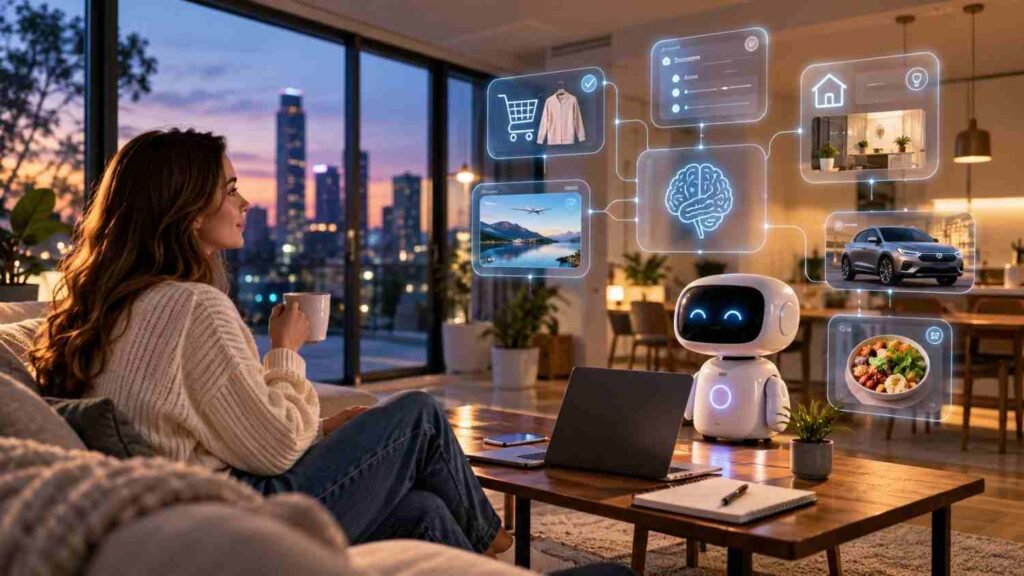
I started noticing that AI on my phone felt less like a search box and more like a layer sitting across the apps I already use. Instead of asking for an answer, I could imagine handing over a small job: compare options, organize details, and report back when needed. That subtle change points toward a different relationship with technology.
I also found that the interesting part is not simply that AI can do more. Consumers are being asked to decide how much control they are willing to give it. An assistant that recommends a product is easy to understand. An agent that chooses the product, places the order, or changes something on my behalf raises a bigger question: when convenience becomes autonomy, where should the human remain in charge?
What Makes Agentic AI Different?
Traditional consumer AI has mostly waited for instructions. You type a question, request an image, ask for a recommendation, or give an assistant a command. Agentic AI changes the model by working toward a goal. It can break requests into steps, use services, evaluate information, and act with less hand-holding.
That distinction moves technology from response generation to task execution. A travel request could involve comparing flights, checking a calendar, and assembling an itinerary. The agent becomes a coordinator.
Smartphones Are Becoming More Proactive

The smartphone shows this shift. Modern devices combine messaging, calendars, location, payments, browsing, and countless apps. An agent that understands this context can turn the phone into a personal operating layer.
That could mean preparing a response, surfacing a reminder, organizing information from several apps, or completing routine actions. The bigger change is that users may stop thinking about which app performs a task.
Consumers also need to know what data an agent can see and when it is acting. Privacy becomes part of the product experience.
Shopping Is Moving From Search Toward Delegation
Shopping is another major testing ground. AI can already help discover products, compare prices, summarize reviews, and narrow choices. NielsenIQ found that 42% of consumers surveyed had used at least one AI tool for shopping within the previous month, while fully autonomous ordering remained much less common. People like assistance before they necessarily want delegation.
Agentic commerce pushes the idea further. A consumer could give an agent a goal and rules. It might find options, apply preferences, watch for a better price, and request approval before purchasing.
Gartner reported in 2026 that only 11% of U.S. consumers surveyed were willing to let AI make purchase decisions, while larger shares were comfortable using AI to narrow choices. Consumers appear more interested in removing tedious work than surrendering judgment.
Everyday Tasks Could Become Agent Workflows
The same pattern extends beyond retail. Scheduling, travel research, subscriptions, and routine digital administration contain repetitive steps that agents could coordinate.
Customer service is a good example. Instead of opening a support page, locating an order, finding a return policy, and submitting a request, an agent could gather relevant details and move the process forward. People may only need to approve an exception.
At home, an agent could coordinate calendars, shopping lists, appointments, and deliveries. The value comes from connecting scattered tasks.
The Interface May Fade Into the Background
If this model works, apps may become less visible. People could increasingly state an outcome instead of navigating a menu. Apps would still provide services and data, but the agent could become the access layer.
This could reshape personalization. Consumers will expect assistants to understand preferences, budgets, routines, priorities, and boundaries. The challenge is making personalization predictable. Useful memory saves time; an unexpected assumption can create problems.
Privacy and Control Become Part of the Experience

Agentic AI creates a different privacy challenge because useful agents need context. A trip planner may need calendar information, while a shopping agent may need payment details. A household assistant could encounter messages, addresses, schedules, and other sensitive information.
That makes visibility and control essential. Users should understand what an agent accessed, which actions it took, and when approval is required. Authentication, spending limits, permission controls, and activity histories can make autonomy easier to trust.
The phrase personal AI assistants and privacy becomes especially relevant because personalization and data access are closely connected. More context can make an agent useful, but it increases the consequences of poor security.
What Consumers Should Expect Next
Agentic AI is likely to arrive unevenly. Low-risk tasks are easier to delegate than financial decisions, purchases, or actions that create lasting consequences. Consumer technology will probably evolve through layers of autonomy rather than one sudden leap.
Trust will be the deciding factor. Consumers may welcome an agent that saves time, but they will expect clear boundaries before letting it spend money or act without asking. Companies that make those boundaries understandable will have an advantage.
FAQs: How Agentic AI Is Changing Consumer Technology in 2026
1. How is agentic AI different from a chatbot?
A chatbot mainly responds to prompts. An agentic system can pursue a goal, plan multiple steps, use tools, and take actions with less direct instruction.
2. Will agentic AI replace smartphone apps?
Probably not completely. Apps will still provide services and data, but consumers may access their capabilities through AI agents instead of navigating each app manually.
3. Is agentic AI safe for shopping?
It can help with research and comparison, but autonomous purchasing requires safeguards. Spending limits, approval steps, secure payments, and activity records can reduce risk.
4. Why does privacy matter more with agentic AI?
Agents may need more personal context to complete tasks effectively. That makes permissions, data protection, transparency, and user control increasingly important.
Why Consumer Technology Is Becoming More Delegated
The most meaningful shift may be surprisingly ordinary. Agentic AI does not need spectacular feats to change how people use technology. If it can handle repetitive tasks, track a delivery, compare a purchase, or coordinate a schedule, the cumulative effect could be significant. Technology starts feeling less like a collection of tools and more like infrastructure working in the background.
The real measure of progress will not be how much autonomy companies can give an agent. It will be how comfortably consumers can use that autonomy, understand what happened, and take control. Convenience may attract people to agentic AI, but trust will determine how far they let it go.