
For two decades, I cast ballots for traditional GOP candidates based on fiscal conservatism, institutional restraint, and free trade. When populism transformed the platform, I joined millions of voters who walked away. Yet evaluating third party viability for disillusioned conservatives requires confronting an uncomfortable arithmetic: our voting system was designed to neutralize alternatives. If you want a functional conservative alternative, you must understand the machinery working against it.
Recent Gallup tracking confirms that independent identification hovers near historic highs. Discontent with standard-bearers runs deep across the country. Still, translating private disaffection into political power runs headlong into structural and behavioral dead ends.
+————————————————————–+
| THE THIRD-PARTY ILLUSION VS. REALITY |
+————————————————————–+
| VOTER SENTIMENT: High disaffection -> High polling demand |
| v |
| BALLOT ACCESS: Strict state petitions + Costly legal moats |
| v |
| BALLOT BOOTH: Plurality voting triggers “spoiler” panic |
| v |
| RESULT: Collapse of raw vote share -> Zero legislative seats|
+————————————————————–+
The Institutional Machine Built to Crush Center-Right Alternatives
The American electoral framework protects the two-party duopoly. Any emerging center-right organization immediately encounters state-sanctioned hurdles designed to eliminate challengers before voters enter the booth.
Duverger’s Law and the Winner-Take-All Trap
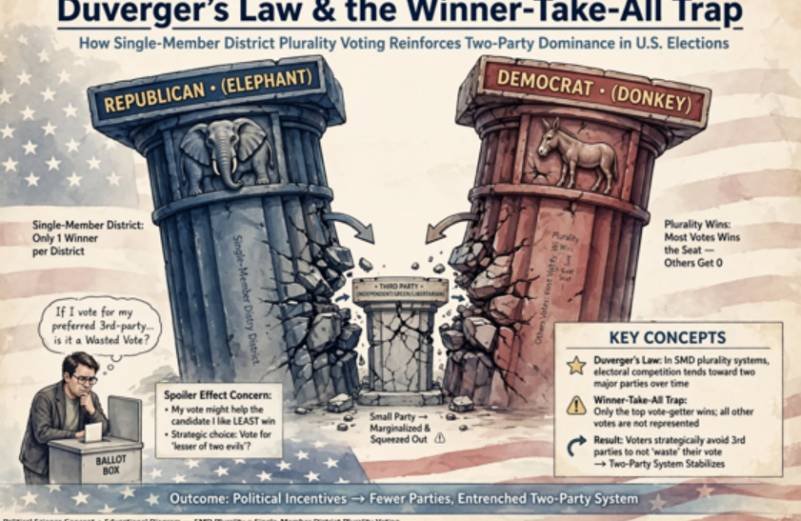
The United States operates primarily on single-member districts decided by plurality voting. French political scientist Maurice Duverger demonstrated that this system mathematically drives a two-party equilibrium.
When a voter enters the booth, strategic calculation overrides ideological affinity. Casting a ballot for a third-party conservative candidate who polls at 6% feels like throwing away leverage. Worse, right-leaning defectors understand the spoiler dynamic: peeling 50,000 votes away from a mainstream Republican in a swing state almost always hands the seat to a progressive rival. The structural mechanics documented by Khan Academy’s Political Science analysis illustrate how plurality voting penalizes coalition splitting. Voters return to the major parties to prevent their worst-case outcome.
Ballot Access Laws as Partisan Moats
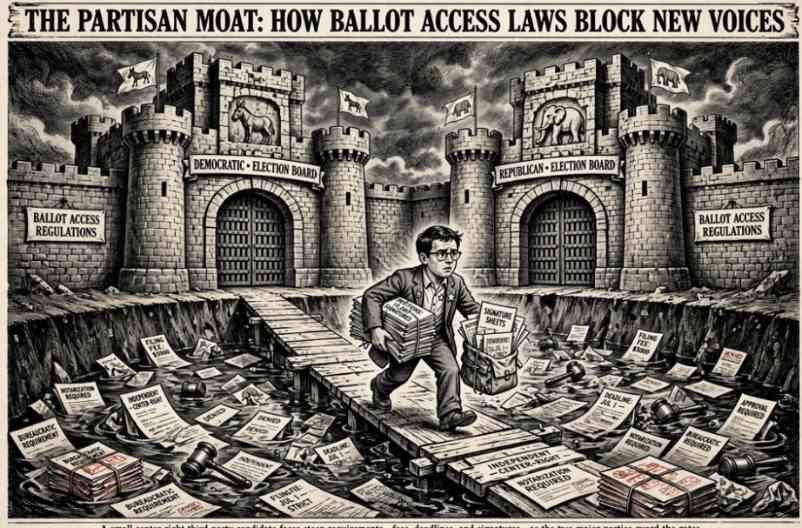
The Democratic and Republican parties jointly govern state election boards. Over decades, they have constructed bureaucratic barriers that drain startup parties of capital.
Gathering hundreds of thousands of certified signatures across fifty distinct jurisdictions requires millions of dollars before running a single television advertisement. In states like California or Texas, signature verification challenges filed by major-party attorneys routinely wipe out alternative slates on technicalities. Minor parties burn their operational budgets on court dates rather than voter persuasion.
The Ideological Crackup: Why Defectors Can’t Agree on Policy
Even if we cleared every legal hurdle, disillusioned conservatives face an internal obstacle: they do not agree on what should replace the current platform.
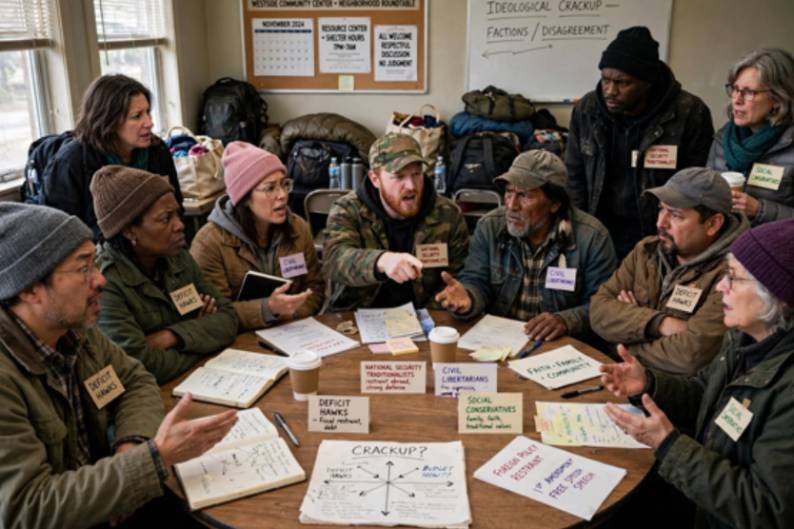
I learned this firsthand organizing local roundtables for independent voters. Put ten self-described “homeless conservatives” in a room, and you will get five incompatible visions for governance.
This mirrors broader trends explored in Why Traditional Conservatives Feel Politically Homeless, where economic hawks, libertarians, and institutionalists find themselves stranded without a shared platform.
| Faction | Primary Priority | Common Sticking Point |
| Deficit Hawks | Slashing entitlement spending, reducing debt | Oppose protectionist tariffs and subsidies |
| National Security Traditionalists | Robust foreign defense, international alliances | Alienated by isolationist trade positions |
| Civil Libertarians | Federal deregulation, free markets | Reject industrial policy and executive expansions |
| Social Conservatives | Judicial restraint, cultural institutions | Clash with center-right libertarians on social policy |
The Populist vs. Constitutionalist Divide
Academic surveys indexed on ResearchGate reveal that voters who express desire for a third party hold polarized policy preferences. When pollsters ask abstract questions, voters demand a generic alternative. The moment you place an actual candidate on the ballot, support fractures.
A principled constitutionalist opposes deficit spending, executive orders, and trade tariffs. Meanwhile, working-class defectors often support border control and entitlement protection, as shown in changing debates surrounding Conservative Views on Immigration Policy.
These two groups cannot cohere around a single party platform. A party that pleases the free-market defense hawk alienates the working-class voter, and vice versa.
This divide also highlights what conservatives believe about free markets, particularly the tension between traditional free-market principles and newer economic approaches shaped by populist priorities.
Data from Pew Research Center reinforces this reality: Americans are not clustering into a unified moderate middle. They are sorting into sharper ideological camps.
Lessons Across the Atlantic: Why the UK Model Fails in America
Disillusioned American conservatives frequently look to Europe for inspiration. In the United Kingdom, Reform UK captured significant vote share by peeling voters away from the traditional Conservative Party.
Parliamentary systems facilitate leverage that the American system rejects. In Britain, regional concentration allows insurgent parties to win localized seats or threaten safe margins, forcing leadership challenges within Parliament.
Our presidential republic operates through a nationwide winner-take-all Electoral College. A conservative splinter party could win 12% of the national popular vote and receive exactly zero electoral votes.
Without legislative representation or coalition-building power, a third party here remains an outside agitator rather than a governing partner.
The Real Win: Platform Co-optation Over Oval Office Fantasy
If winning majorities is impossible under our rules, does building an alternative matter? It does, but only if you adjust your metric of success.
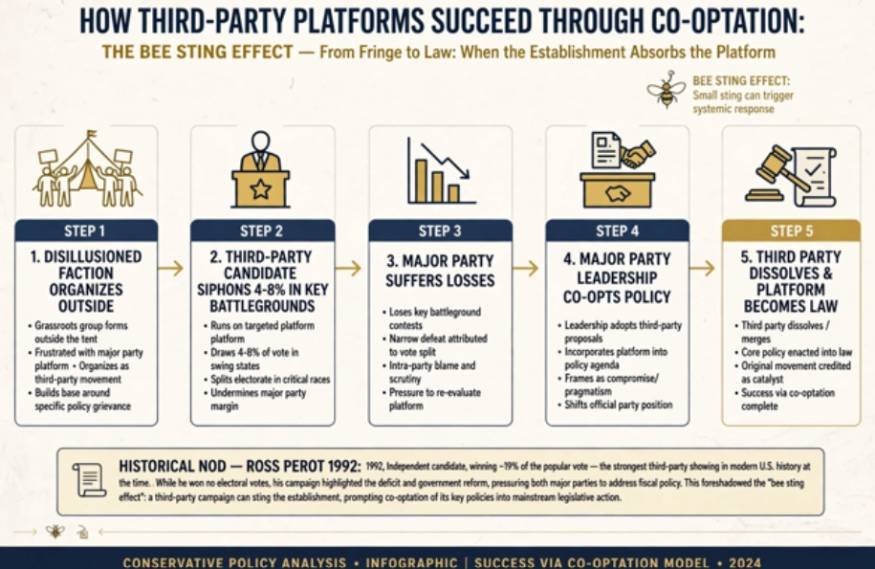
Third parties in American history succeed by losing strategically. In political science, minor parties function like the bee: they sting, and then they die. When an insurgent movement siphons enough support to cost a major party an election, that major party absorbs the insurgent’s core platform to reclaim those voters.
[Disillusioned Faction Organizes Outside the Tent]
│
▼
[Third-Party Candidate Siphons 4-8% in Key Battlegrounds]
│
▼
[Major Party Suffers Costly General Election Losses]
│
▼
[Major Party Leadership Co-opts Policy to Rebuild Base]
│
▼
[Third Party Dissolves; Platform Becomes Law]
Consider Ross Perot in 1992. His independent candidacy won nearly 19% of the popular vote on a platform focused on national debt and deficit reduction. He never carried an electoral vote, but he terrified both parties.
House Republicans responded with the 1994 Contract with America, and the Clinton administration prioritized deficit elimination, producing balanced federal budgets by 1998. Perot lost the White House, but his platform won national policy.
Stop Waiting for a Savior Party—Become a Hostile Voter
Launching a national third party with dreams of holding the presidency is a waste of donor capital. The structural barriers are too high, and ideological division among defectors is too broad.
If you are a disillusioned conservative, your real power lies in making your vote expensive. Stop offering reflexive support to candidates who violate your principles, and stop waiting for an immaculate new party to emerge from nowhere.
Organize locally. Support single-issue primary challengers. Back electoral reforms like ranked-choice voting that remove the spoiler penalty. When a major party realizes it cannot win without earning your coalition back, you will see your principles restored to the national agenda.
Frequently Asked Questions
1. Can a conservative third party realistically win the US presidency?
No, the combination of plurality voting, ballot access costs, and Electoral College mechanics prevents minor parties from winning national executive office.
2. What is the most successful conservative third-party effort in modern history?
Ross Perot’s 1992 campaign secured nearly 19% of the popular vote, compelling both major parties to prioritize federal deficit reduction.
3. Does voting for a third party simply spoil the election for the left?
Under standard plurality rules, splintering center-right votes almost always benefits the opposing progressive party in close races.
4. What electoral reform would make third parties viable in the United States?
Ranked-choice voting and proportional representation remove the fear of “wasted votes” and give third parties real legislative viability.