
I have spent years navigating federal agency dockets, watching unelected rulemakers draft sweeping decrees behind closed doors. When citizens confront Washington, they rarely battle statutes passed by their elected representatives. Instead, they face unaccountable federal administrative state policy overreach—a bureaucratic machinery that writes binding mandates, enforces them with aggressive audits, and penalizes citizens in administrative tribunals.
This is not governance by consent. It is rule by executive memo.
The Phantom Fourth Branch: How Regulatory Agencies Bypass Article I
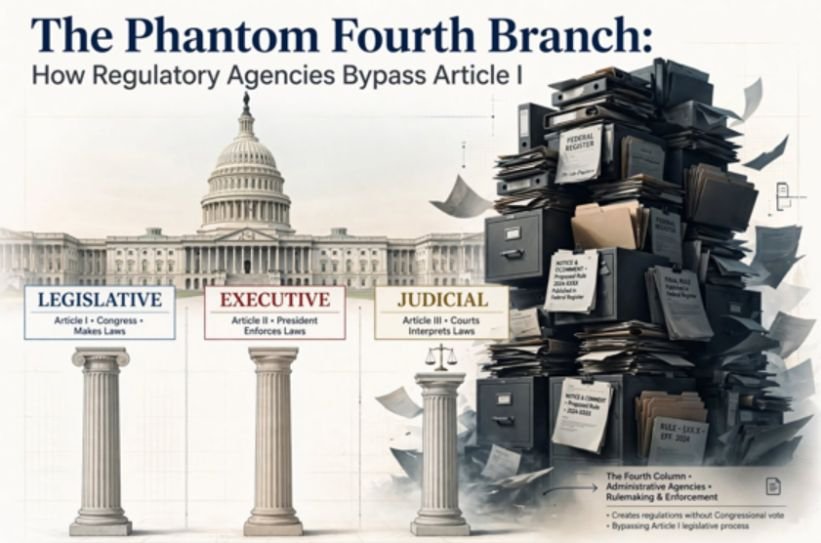
The Constitution establishes three distinct branches: legislative, executive, and judicial. Yet more than two million career bureaucrats now operate as a de facto fourth branch.
Congress writes broad, aspirational statutes. Lawmakers hand agencies vague mandates to ensure “public health” or establish “reasonable rates.” In turn, agencies convert statutory ambiguities into thousands of pages of binding rules in the Federal Register.
By transferring complex decisions to agency staff, lawmakers avoid hard votes while bureaucrats gain immense governing power.
When Agency Guidance Replaces Statutory Law
The real danger often lies beneath official rulemaking in what scholars call “regulatory dark matter.” Agencies frequently bypass the formal notice-and-comment process mandated by the Administrative Procedure Act. Instead, they publish informal manuals, “Dear Colleague” letters, and FAQs.
I have seen small businesses spend tens of thousands of dollars altering operations simply because an agency issued a non-binding PDF on its website. Legally, these guidance documents claim to be advisory. Practically, ignoring them triggers an immediate audit, an enforcement letter, or debilitating litigation.
The Enforcement Paradox: Investigator, Prosecutor, and Judge
Article III guarantees citizens an independent judicial forum and a jury of their peers. Within the administrative state, agencies routinely consolidate all powers under one roof.
An agency writes the standard, investigates the alleged violation, brings the charges, and assigns an Administrative Law Judge (ALJ) on its own payroll to adjudicate the dispute. This internal tribunal system forces defendants to battle the federal government on its home turf before ever setting foot in a constitutional court.
The Constitutional Collision: Unitary Control vs. Civil Service Tenure
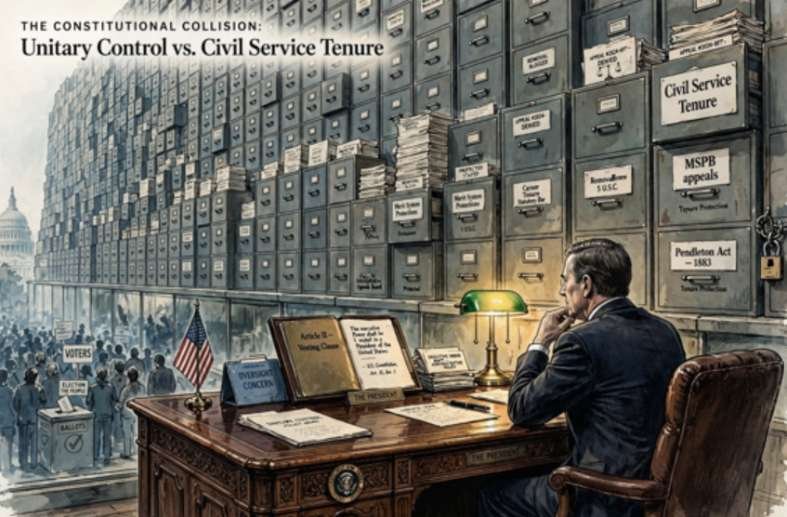
Democratic legitimacy requires executive accountability. If an administration enacts harmful policies, voters can replace the President. However, that accountability breaks down when career officials cannot be managed or dismissed by the elected Commander-in-Chief.
Why the President Cannot Simply Fire Subordinates
Article II’s Vesting Clause places all executive authority in the President. Yet, the civil service framework codified in the 1883 Pendleton Act and expanded by the 1978 Civil Service Reform Act creates statutory insulation for career employees.
Unless an official commits gross misconduct, firing them requires navigating an exhaustive appeals process before the Merit Systems Protection Board. While these safeguards were designed to prevent partisan corruption, they also insulate policy-level decisions from executive control, creating an institutional wall between voters and the bureaucracy.
The broader history of partisan realignment also provides useful context for understanding when did the republican and democratic parties switch, particularly as competing views of executive authority, federal administration, and institutional governance evolved over time.
Bureaucratic Drift and the Political Divide
This insulation has intensified political tensions across Washington, where the gop establishment has historically accommodated bureaucratic expansion, treating administrative growth as an unavoidable consequence of managing an increasingly complex federal apparatus.
In contrast, disillusioned conservatives view the entrenched civil service as an unconstitutional obstacle that resists presidential policy directives with total impunity.
This rift has turned agency reform into a top constitutional battleground, producing calls to reclassify career positions into at-will roles.
The broader debate over third party viability for disillusioned conservatives further illustrates how institutional dissatisfaction can evolve into demands for fundamental political and governmental reform.
Dismantling the Shield: The Post-Chevron Legal Landscape
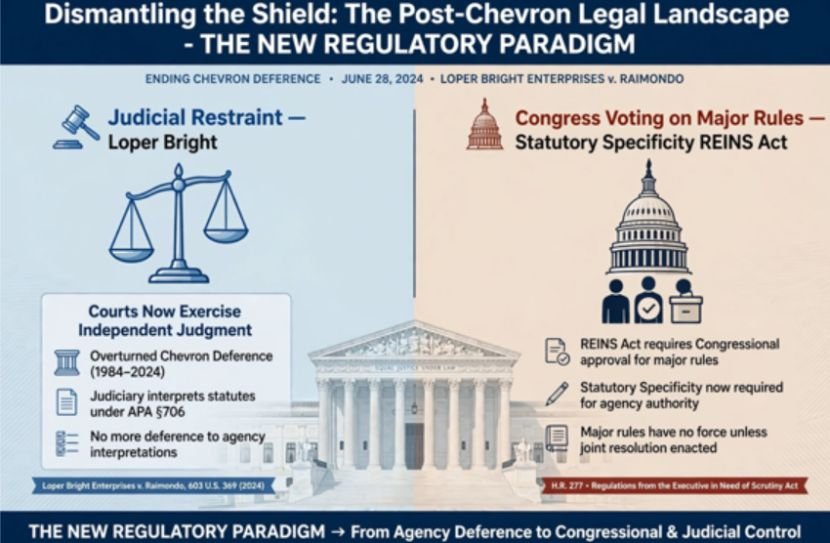
The legal foundation supporting agency independence is undergoing its most dramatic contraction in four decades.
THE NEW REGULATORY PARADIGM
│
┌───────────────────────┴───────────────────────┐
▼ ▼
Judicial Restraint (*Loper Bright*) Statutory Specificity
- Federal judges interpret statutes • Congress must authorize major rules
- End of automatic agency deference • End of vague delegations
Ending Deference in the Federal Courts
For forty years, the doctrine established in Chevron U.S.A. v. NRDC required federal courts to defer to reasonable agency interpretations of ambiguous statutes. As detailed in resources compiled by the Cornell Law School Legal Information Institute, this precedent allowed agencies to expand their own authority simply by declaring a statute unclear.
The Supreme Court fundamentally altered this dynamic in Loper Bright Enterprises v. Raimondo. The ruling clarified that the Administrative Procedure Act requires courts, not agencies, to exercise independent judgment when interpreting the law, as reflected in official U.S. Supreme Court Opinions. The era of courts serving as rubber stamps for bureaucratic expansion has ended.
Legislative Clawbacks and the REINS Act Framework
Judicial review alone cannot restore balance; Congress must also reclaim its constitutional lawmaking duties. Proposals like the Regulations from the Executive in Need of Scrutiny (REINS) Act seek to reverse the default path of major regulation.
Instead of an agency publishing a major economic rule that takes effect automatically, the REINS Act would require both chambers of Congress to affirmatively vote to approve any regulation imposing over $100 million in economic impact.
As researchers at the Brookings Institution note, returning this authority to Congress forces elected lawmakers to take public responsibility for the economic mandates imposed on the country.
Reclaiming Democratic Accountability: Time to Cut the Red Tape
The fight against bureaucratic overreach is not about removing basic safety rules; it is about who holds the power to make law in a free society. When unelected civil servants dictate national economic policy without legislative approval or direct executive oversight, self-governance gives way to technocracy.
If you own a business, follow agency rulemakings, or care about constitutional limits, do not treat administrative guidance as unquestionable authority. Challenge vague mandates, comment during open federal dockets, and hold your elected lawmakers accountable for every major power they surrender to the executive apparatus.
Frequently Asked Questions
1. What does administrative state policy overreach mean?
It refers to federal agencies enacting sweeping mandates and penalties that exceed statutory authority granted by Congress.
2. How did the overturning of Chevron deference curb agency overreach?
It stripped agencies of automatic judicial deference, returning the exclusive power of statutory interpretation to federal judges.
3. Why is civil service reform central to addressing administrative overreach?
It allows an elected President to hold entrenched agency personnel accountable to voter mandates through direct oversight.
4. What is the primary purpose of the REINS Act?
It requires Congress to affirmatively approve economically significant federal regulations before they can take legal effect.