
Watching congressional floor negotiations collapse from behind the committee room doors reveals a stark reality: Capitol Hill no longer operates on standard bargaining logic. The tangible consequences of political polarization on Republican governance have fundamentally dismantled how the party exercises power at both state and national levels.
Where Republican leadership once built legislative coalitions around deregulation and fiscal conservatism, partisan sorting now forces lawmakers to govern under perpetual internal threat. The primary objective is no longer managing a durable majority; it is surviving the political crossfire created by intense ideological purity tests.
The Breakdown of the Legislative Engine

During my years tracking congressional negotiations, Republican leadership relied on a predictable whip count. A speaker could concede on a highway demonstration project or agricultural subsidy to secure centrist votes, confident that their right flank would hold the line on final passage. Today, that playbook is dead.
From Policy Delivery to Negative Partisanship
Negative partisanship—the electoral instinct to rally voters primarily through fear and disgust of the opposition—now drives legislative planning. Scholars at the Pew Research Center have documented how cross-party animus has expanded over recent decades.
For Republican officials, this dynamic rewards blocking Democratic initiatives over advancing affirmative statutory platforms. Landmark legislative packages require compromise, but compromise reads as betrayal on the evening news.
Consequently, congressional majorities devote precious floor calendar days to messaging bills and oversight hearings designed for digital media distribution rather than statutory reform.
The Primary Penalty and the Death of Cross-Aisle Compromise
The traditional center-right coalition has vanished because modern primary voters actively penalize bipartisan cooperation. In deep-red congressional districts drawn to ensure lopsided general election outcomes, the general election is essentially a formality. The real contest occurs months earlier in low-turnout primaries.
The real contest occurs months earlier in low-turnout primaries. This dynamic is closely connected to Republican Party Primary Election Voter Fatigue, particularly as declining enthusiasm and voter fatigue can reshape participation patterns within primary contests.
A single vote across the aisle on immigration reform, debt ceiling adjustments, or infrastructure invites a primary challenger backed by activist fundraising networks.
Conversations with former members of Congress consistently reveal a recurring pattern: pragmatic lawmakers increasingly choose retirement rather than spend their legislative careers navigating an increasingly precarious ideological tightrope.
This institutional attrition creates a political vacuum that is progressively being occupied by disillusioned conservatives and more uncompromising ideological factions, reinforcing the broader dynamics examined in third party viability for disillusioned conservatives.
::
Factional Warfare Inside the Majority

The most visible friction in modern Republican governance is not between Republicans and Democrats. It is between Republicans and other Republicans.
Ideological Distance & Primary Sorting
│
▼
Shrinking General-Election Margins
│
▼
Empowered Factional Veto Blocs (e.g., Freedom Caucus)
│
▼
Speakership Volatility & Procedural Hostage-Taking
The Rise of Procedural Veto Enclaves
A standard legislative majority requires 218 House votes. When that majority sits at just a handful of seats, small factional blocs like the House Freedom Caucus operate as de facto veto players.
As researchers at the Carnegie Endowment for International Peace have noted, asymmetric polarization has accelerated internal ideological fracturing within legislative bodies.
These factions rarely seek conventional policy logrolling. Instead, they demand structural concessions:
- Relaxed thresholds for “motion to vacate” resolutions.
- Guaranteed committee seats for ideological hardliners.
- Unbending spending caps on regular appropriations bills.
These dynamics produce historic leadership instability. Speakers find themselves held hostage by their own members during routine governing exercises, such as funding the federal government or reauthorizing national defense bills. To pass must-pass legislation, leadership must eventually cut emergency deals with Democrats, which immediately triggers procedural revolts from the right wing.
Shifting Strategy: Courts, Preemption, and Unilateral Power
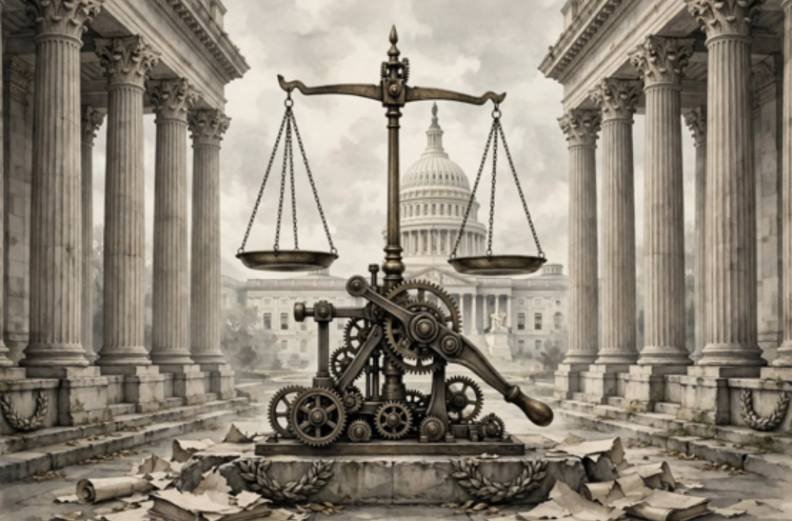
Because congressional polarization creates systemic legislative paralysis, conservative governance has pivoted away from statutory lawmaking toward the judicial and executive branches.
Deconstructing Administrative Authority Through the Judiciary
Realizing that sweeping conservative deregulation cannot easily survive a 60-vote Senate filibuster, Republican governance has made the federal judiciary its central policy lever. Over multiple administrations, confirming conservative appellate and Supreme Court judges became the party’s highest-yield enterprise.
This strategy yielded transformative administrative results. Through strategic litigation brought by allied state attorneys general, conservative legal movements dismantled structural precedents, culminating in the rollback of long-standing agency deference doctrines. By steering contentious questions into federal courtrooms, the party effectively reshapes federal administrative state policy without relying on fragile congressional majorities.
This approach is closely examined in Unaccountable Federal Administrative State Policy Overreach, which explores the broader implications of expanding administrative authority and the institutional mechanisms used to constrain it.
Executive orders present another vital, albeit temporary, governing path. When in control of the White House, Republican presidents utilize unilateral executive actions to pause regulatory rules, shift immigration enforcement policies, and redirect federal procurement.
While highly vulnerable to reversals under subsequent administrations, these executive decrees offer immediate policy execution while Capitol Hill remains deadlocked.
Down-Ballot Shockwaves: The Nationalization of State Policy
Polarization has eradicated the traditional boundary between local management and national cultural battles. Not long ago, Republican governors distinguished themselves through fiscal administration, port management, tax reform, and municipal services.
An analysis from the Brookings Institution underscores how institutional norms have changed as abrasive adversarialism displaced regional consensus-building. Today, governors and state legislators frequently treat state capitols as laboratories for national culture-war issues.
From state-level restrictions on corporate environmental criteria (ESG) to curriculum mandates in public school systems, down-ballot Republican policymakers operate under intense pressure to mirror national television discourse rather than address localized infrastructure problems.
Frequently Asked Questions
1. What are the main consequences of political polarization on Republican governance?
Polarization creates intra-party fragmentation, destabilizes legislative leadership, and shifts the party’s policy focus from drafting broad statutes to appointing conservative judges.
2. How does negative partisanship impact Republican lawmaking?
It incentivizes lawmakers to prioritize opposition, investigations, and media-focused messaging bills over collaborative, bipartisan legislation.
3. Why do House Republican speakers struggle with party discipline?
Razor-thin majorities give small, ideologically rigid factions outsized leverage to block routine bills and threaten leadership removals.
4. How has judicial strategy replaced traditional conservative legislation?
Blocked by congressional gridlock, Republicans rely on the federal courts to curtail administrative agency reach and secure long-term deregulatory outcomes.
Beyond the Partisan Trenches
Polarization has permanently transformed Republican governance from an exercise in pragmatic bargaining to a high-stakes campaign of ideological survival. While this environment rewards hardline positions during primary seasons, it extracts a heavy toll on the party’s ability to maintain stable legislative majorities and pass durable national laws.
If you want to track where Republican policy actually moves next, stop watching the congressional floor debates. Watch the federal court dockets, the emergency spending compromises, and the state-level executive actions—because in an era of deep polarization, that is where modern governance truly happens.